
B2B Ecommerce Website for Manufacturing Companies: How to Turn Complex Product Catalogs into Qualified RFQs

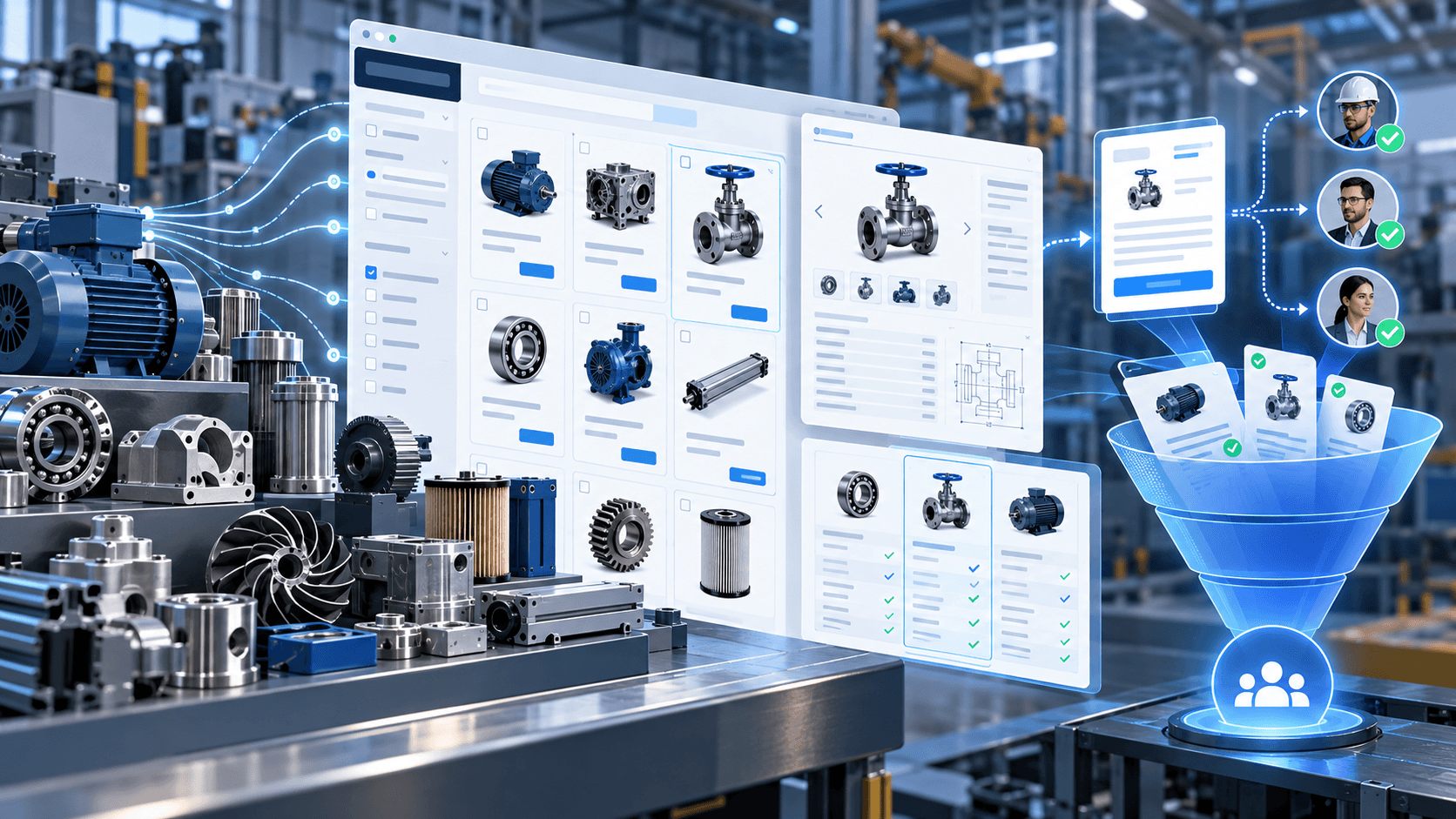
Manufacturing companies often have a website problem that looks like an ecommerce problem but is actually much more complex.
The company may sell hundreds or thousands of products, components, spare parts, machines, industrial systems, or configurable solutions. Buyers need detailed specifications, compatibility information, technical documents, and sometimes engineering support before they can purchase anything.
A conventional ecommerce store built around product photos, prices, and an “Add to Cart” button is often not enough.
For many manufacturers, the real website conversion is not an immediate online purchase. It is a qualified RFQ, technical inquiry, distributor request, or conversation with a sales engineer.
This changes how the entire website should be designed.
This article explains how manufacturing companies can structure a B2B ecommerce website that helps technical buyers navigate complex catalogs and turns product research into qualified sales opportunities.
Why Manufacturing Ecommerce Is Different
A consumer ecommerce buyer may know exactly what they want and complete a purchase within minutes.
An industrial buyer may need to evaluate:
- technical specifications;
- operating conditions;
- dimensions;
- materials;
- compatibility;
- certifications;
- minimum order quantities;
- availability;
- lead times;
- custom configuration;
- delivery geography;
- after-sales support.
More than one person may participate in the decision.
The website can be used by:
- engineers;
- procurement managers;
- technical directors;
- distributors;
- project managers;
- maintenance teams;
- company owners.
Each person may enter the website with a different question.
The website therefore has to function as a product catalog, technical reference system, qualification tool, and sales channel at the same time.
The Common Problem: A Huge Catalog with No Clear Buyer Path
A common manufacturing website contains many products but gives buyers very little help choosing between them.
The structure may look like this:
- large top-level categories;
- hundreds of product cards;
- similar product names;
- technical PDFs;
- basic filters;
- one generic contact form.
From the company’s perspective, the catalog is complete.
From the buyer’s perspective, it may be difficult to use.
If a visitor has to open ten product pages and several PDFs simply to understand which model fits their application, the website is pushing product selection work back onto the customer.
That increases friction and reduces inquiries.
Start with Buyer Logic, Not the Internal ERP Structure
One of the biggest mistakes in industrial ecommerce development is copying the company’s internal product classification directly into the website.
The internal catalog may be organized around:
- production departments;
- internal product codes;
- supplier structure;
- warehouse categories;
- ERP groups.
Buyers may think differently.
They may search by:
- application;
- industry;
- equipment type;
- technical parameter;
- compatibility;
- material;
- capacity;
- problem they are trying to solve.
A strong B2B ecommerce architecture should bridge both systems.
The backend can preserve the company’s operational logic while the frontend presents products in a way that matches how buyers actually search and compare.
Build Categories Around Commercial Search Intent
Category pages are especially important for manufacturers because they often become the main entry point from organic search.
A weak category may simply contain a grid of products.
A strong category helps the buyer understand:
- what products belong to the group;
- which applications they are designed for;
- how models differ;
- which specifications matter;
- how to choose the correct option;
- what to do if the buyer needs assistance.
For example, a broad category such as:
Industrial Pumps
may need narrower commercial subcategories based on actual demand:
- Chemical Transfer Pumps;
- High-Temperature Industrial Pumps;
- Food-Grade Process Pumps;
- Pumps for Corrosive Liquids;
- Compact Pumps for OEM Equipment.
The right structure depends on the product line and search demand, but the principle is the same: categories should help buyers reduce their options.
Filters Should Help Engineers Make Decisions
Filters are not just an ecommerce convenience in industrial catalogs. They can become part of the technical selection process.
Useful filters may include:
- capacity;
- voltage;
- pressure;
- temperature range;
- material;
- connection type;
- power;
- dimensions;
- certification;
- application;
- manufacturer;
- compatibility.
The filters should reflect parameters that buyers genuinely use when specifying equipment.
Adding every database attribute as a filter usually creates clutter.
The objective is not to maximize filter count. It is to reduce selection complexity.
Filter implementation also needs technical SEO control because uncontrolled parameter combinations can generate thousands of low-value URLs.
Product Pages Need More Than Specifications
Industrial product pages often contain extensive specification tables but very little decision-support content.
A specification table is important, but it does not answer every buyer question.
A strong product page can include:
- clear product identification;
- short application summary;
- key technical specifications;
- available configurations;
- compatible equipment;
- materials;
- operating limits;
- certifications;
- technical drawings;
- manuals and documentation;
- delivery or production information where appropriate;
- related accessories;
- replacement or alternative models;
- RFQ or technical consultation CTA.
The buyer should not have to contact sales simply to obtain basic information that could safely be published online.
Sales should become involved when professional judgment, pricing, configuration, or project context is actually needed.
Use Product Comparison for Similar Models
Complex industrial catalogs frequently contain several models that look almost identical to a non-specialist.
Forcing buyers to open each product in a separate tab creates unnecessary friction.
A comparison function can show differences such as:
- capacity;
- dimensions;
- performance;
- materials;
- environmental limits;
- certifications;
- supported applications.
This is particularly useful when products belong to the same family but are designed for different operating conditions.
A good comparison page also creates another opportunity for a relevant CTA:
Not sure which configuration fits your application? Send the requirements to our technical team.
RFQ Should Be a Product Workflow, Not a Generic Contact Form
A generic “Contact Us” form wastes information that the buyer already provided through their browsing behavior.
If a visitor is viewing a specific product, the RFQ form should know which product they are interested in.
A useful product RFQ workflow can automatically include:
- product name;
- SKU or model number;
- selected configuration;
- requested quantity;
- product URL.
The buyer can then add:
- company name;
- business email;
- country;
- required quantity;
- project details;
- delivery requirements;
- technical questions.
This produces a significantly better sales inquiry than a message saying:
“Please send more information.”
The website should help the sales team understand the opportunity before they respond.
Consider Multi-Product RFQ Instead of a Shopping Cart
Some B2B manufacturers do not need traditional online checkout at all.
A better model may be an RFQ basket.
The buyer can:
- browse several products;
- add relevant models to an inquiry list;
- specify quantities;
- attach project requirements;
- send one structured request.
This preserves the familiar ecommerce interaction without forcing the business into fixed online pricing or immediate checkout.
It is particularly useful when pricing depends on:
- volume;
- configuration;
- delivery country;
- contract terms;
- project requirements;
- custom manufacturing.
Technical Documents Should Support the Buyer Journey
Manufacturing websites often have valuable technical documentation but hide it inside large PDF libraries.
Documentation should be connected directly to relevant products and categories.
This can include:
- datasheets;
- installation manuals;
- CAD files;
- technical drawings;
- certificates;
- material documentation;
- compatibility charts;
- maintenance instructions.
The buyer should not have to search the entire website to find a drawing for the product currently on screen.
Where appropriate, technical documentation can also support organic search with useful HTML content around important questions rather than relying entirely on PDFs.
Create Application Pages, Not Only Product Pages
Buyers sometimes search for a solution before they know which product category they need.
This makes application pages valuable.
Examples could include:
- Components for Food Processing Lines;
- Equipment for High-Temperature Environments;
- Automation Components for Packaging Machines;
- Replacement Parts for Industrial Pumps;
- Solutions for Corrosive Chemical Handling.
An application page can explain the operating problem and then connect buyers to relevant product families.
This creates a useful bridge between problem-led search intent and the product catalog.
Industry Pages Can Qualify Commercial Traffic
If the same manufacturer serves several industries, dedicated industry pages may help both SEO and conversion.
Examples:
- Industrial Components for Food Manufacturers;
- Automation Solutions for Packaging Companies;
- Equipment for Pharmaceutical Production;
- Components for Renewable Energy Systems;
- Industrial Parts for OEM Manufacturers.
These pages should not simply repeat the same generic content with a different industry name.
A useful industry page should explain:
- relevant applications;
- industry-specific requirements;
- common technical problems;
- appropriate product groups;
- certifications or standards where relevant;
- project examples;
- a logical consultation path.
Search Functionality Matters More as the Catalog Grows
A large manufacturing catalog needs reliable internal search.
Buyers may search using:
- product name;
- SKU;
- old part number;
- technical parameter;
- manufacturer code;
- replacement model.
The search should tolerate realistic buyer behavior.
For example, if a distributor enters an exact product code, the site should not return zero results because the database stores the code with a dash in a different position.
Search analytics can also reveal what buyers are trying to find but cannot locate through navigation.
That information is valuable for both UX and product strategy.
Do Not Force Ecommerce Features the Business Does Not Need
B2B ecommerce does not automatically mean:
- public prices;
- credit card checkout;
- consumer-style promotions;
- instant shipping calculation;
- one-click purchases.
The right functionality depends on the sales model.
A manufacturing website may instead need:
- RFQ workflow;
- dealer login;
- customer-specific pricing;
- minimum quantities;
- bulk ordering;
- saved product lists;
- repeat ordering;
- ERP integration;
- CRM integration;
- distributor inquiries.
The platform should support the company’s actual sales process rather than copying consumer ecommerce conventions.
ERP and CRM Integration Can Remove Manual Sales Work
Large product catalogs become difficult to maintain manually.
Depending on the business, integration may synchronize:
- product information;
- SKU data;
- stock;
- pricing;
- customer accounts;
- orders;
- RFQs;
- lead information.
The objective is not integration for its own sake.
The objective is to avoid situations where website information becomes outdated or sales staff manually re-enter every inquiry into internal systems.
Integration architecture should be planned before development because retrofitting it after launch can become expensive.
Multilingual Architecture Matters for European Manufacturing Sales
Manufacturing companies selling across Europe may need several language versions.
Translation alone is not enough.
Technical terminology, documentation, product attributes, metadata, and URLs need consistent handling.
The architecture should account for:
- language-specific URLs;
- hreflang;
- translated product data;
- localized categories;
- market-specific contact information;
- documentation languages;
- regional product availability where relevant.
This should be designed early rather than added after thousands of products have already been published.
SEO Must Be Built into the Catalog Architecture
Industrial ecommerce SEO problems often originate during development.
Common issues include:
- duplicate product URLs;
- uncontrolled filters;
- thin categories;
- duplicate product descriptions;
- poor internal linking;
- incorrect canonical tags;
- parameter indexation;
- weak pagination handling;
- orphan product pages;
- duplicate multilingual pages.
Trying to repair these problems after tens of thousands of URLs are indexed is much more difficult than designing the architecture correctly from the beginning.
SEO requirements should therefore be part of the development specification, not a separate task added after launch.
Measure Qualified RFQs, Not Just Ecommerce Traffic
A manufacturing website can attract significant traffic while generating poor business results.
Useful measurement should therefore include:
- product page visits;
- category-to-product movement;
- technical document downloads;
- RFQ starts;
- completed RFQs;
- products included in RFQs;
- company and country of inquiry;
- traffic source;
- qualified sales opportunity;
- eventual revenue where CRM attribution is possible.
This allows the business to identify which categories and product groups actually generate commercial demand.
A product category producing five strong industrial projects can be more important than one producing thousands of informational visits.
B2B Manufacturing Ecommerce Checklist
- Catalog structure reflects buyer logic, not only internal ERP groups.
- Categories target meaningful product and application intent.
- Filters use technically relevant attributes.
- Filter URLs are controlled for SEO.
- Product pages include enough information for technical evaluation.
- Similar models can be compared easily.
- RFQ requests retain product and configuration context.
- Multi-product inquiries are supported where appropriate.
- Technical documentation is connected to relevant products.
- Application and industry pages support product discovery.
- Internal search handles SKUs and technical identifiers.
- Ecommerce functions match the company’s real sales model.
- ERP and CRM integrations are planned early.
- Multilingual architecture is designed before catalog expansion.
- SEO requirements are included during development.
- Analytics tracks qualified RFQs and sales opportunities.
FAQ
Does a B2B manufacturing website need online checkout?
Not necessarily. If pricing, configuration, quantities, or delivery terms require individual calculation, an RFQ workflow may fit the sales process better than traditional checkout.
How should a large industrial product catalog be organized?
It should reflect how buyers search and select products. Categories, applications, technical filters, industry pages, and internal search can work together instead of relying on one rigid hierarchy.
Can product filters create SEO problems?
Yes. Uncontrolled filter combinations can generate large numbers of duplicate or low-value URLs. Filter indexation should be designed intentionally rather than allowing every combination into search.
What should an industrial RFQ form collect?
The form should preserve the selected product or configuration and request enough business and project information to help sales evaluate the inquiry without creating unnecessary friction.
Conclusion
A successful manufacturing ecommerce website is not simply an online version of a printed product catalog.
It should help engineers and procurement teams find relevant products, compare technical options, access documentation, understand applications, and submit structured inquiries without unnecessary friction.
For manufacturers selling complex products into the US or European B2B market, catalog architecture, RFQ workflows, technical search, ERP integration, multilingual structure, and SEO need to be planned as one system.
If your manufacturing website has a large product catalog but generates too few qualified inquiries, our team can review the ecommerce architecture, product structure, RFQ process, integrations, and SEO requirements before recommending a rebuild.
You may also want to read our articles about ecommerce category structure, OpenCart duplicate URL cleanup, multilingual website SEO, and B2B brochure websites that need stronger lead generation.